
A conventional softener has one resin tank. While it regenerates, the household gets hard water.
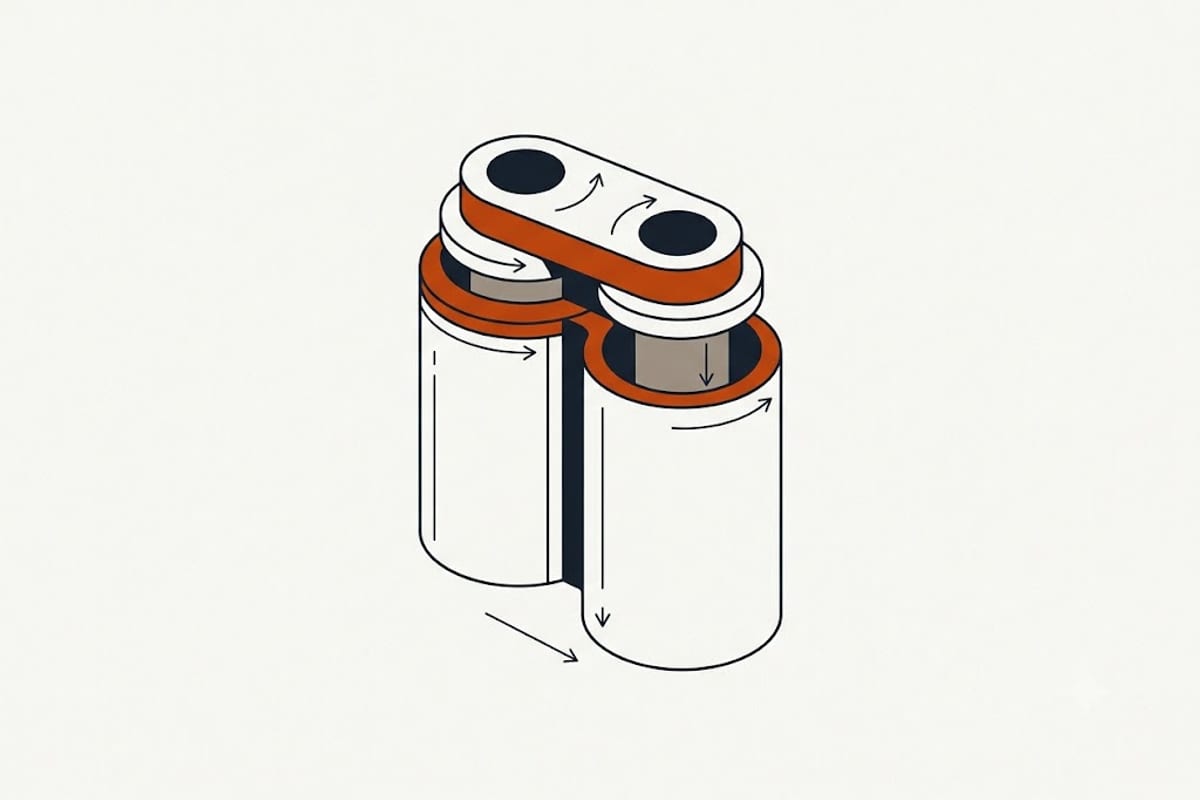
The single-tank limitation
Regeneration takes an hour or two, and the unit is out of service for that period.
This is normally scheduled for the early hours, when nobody is drawing water, and for most households it is entirely invisible.
It matters where:
Water is used around the clock — a large household, shift workers, a home business.
Demand is high enough that regeneration is needed more than once a day, which a single tank cannot do without leaving a gap.
The reserve runs out before the scheduled regeneration on an unusually heavy day, delivering hard water at the tap.
Twin-tank units
Two resin tanks with a shared valve. One is in service while the other is regenerated and then held ready.
Soft water continuously, with no gap.
Regeneration on exhaustion, not on a schedule, because there is no need to wait for a quiet hour. The bed is used to its full capacity every time, which is more salt-efficient.
No reserve capacity needed, since the switch is instant — a single-tank unit has to regenerate early enough to avoid running out, which wastes some capacity every cycle.
The trade-offs
Cost, higher to buy.
Space, two tanks instead of one.
Complexity, one valve doing more.
Regeneration water and salt per cycle are similar; the efficiency gain comes from using the full bed rather than from using less per regeneration.
Where a single tank is the right answer
Most households.
A correctly sized single-tank unit with demand-initiated regeneration, set to run in the early hours, serves a normal family without anyone noticing the gap.
The case for twin tanks is specific: continuous demand, very high use, or very hard water requiring frequent regeneration.
Flow rate, separately from capacity
A point that applies to both types.
Grain capacity determines how much hardness is removed between regenerations. Service flow rate determines how fast water can pass and still be softened properly.
A household running two showers and a washing machine simultaneously needs a unit rated for that flow. A unit adequate on capacity and short on flow delivers partly softened water at peak times, which reads as the softener not working.
Both figures are on the specification and only the first is usually discussed.
Upflow and downflow regeneration
Downflow is the traditional arrangement, with the brine passing down through the bed.
Upflow brine regeneration passes it upward, contacting the least-exhausted resin last, which uses noticeably less salt for the same capacity.
Most efficient current units use upflow, and it is worth asking about, since it affects the running cost more than most of the other choices.
What to specify
Capacity from the grain-load calculation. Service flow rate from the household's simultaneous demand. Metered, demand-initiated control. An efficient salt setting. And single or twin tanks according to whether the household actually has a continuous demand — which most do not.
Commercial-style units in houses
Twin-tank designs come from commercial water treatment, where continuous supply is a requirement rather than a preference.
That heritage brings sturdier valves and better parts availability on some models, and it also brings physical size and a price that only makes sense where the demand justifies it.
Where the money is better spent
For most households, the improvements that matter more than a second tank are:
Correct sizing from a measured hardness and a real grain load.
Metered, demand-initiated regeneration instead of a timer.
An efficient salt setting rather than the maximum dose.
Iron removed ahead of the softener, where iron is present.
Each of those improves both performance and running cost, and together they cost less than the step up to twin tanks.