A well pump is not sized to run whenever a tap opens. A pressure tank stores water under pressure so small draws are served without starting it.
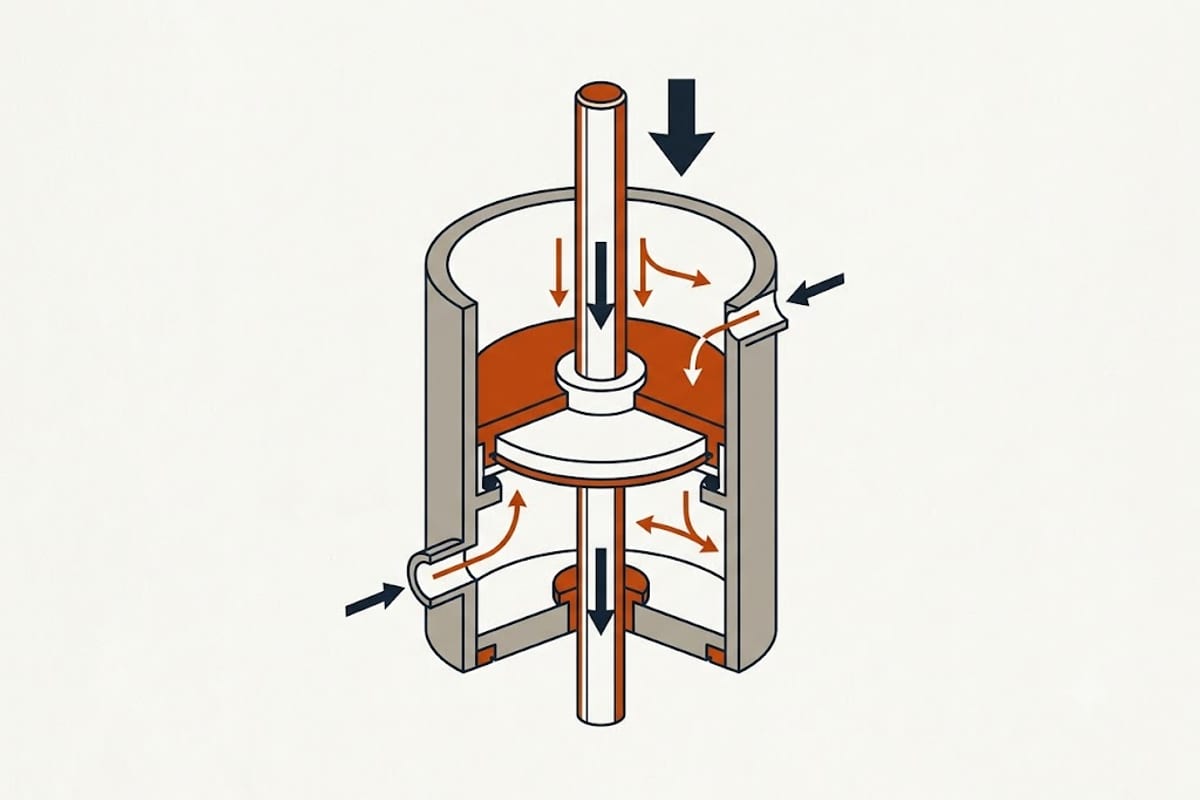
How it works
The tank has a bladder or diaphragm separating an air charge from the water.
The pump fills the water side, compressing the air. When a tap opens, the compressed air pushes water out. When the pressure falls to the cut-in, the pump starts; when it reaches the cut-out, it stops.
The volume delivered between those two points is the drawdown, and it is what determines how long the pump stays off.
The two numbers
Cut-in and cut-out, set by the pressure switch. Common settings are 30/50 and 40/60 psi.
Precharge, the air pressure in an empty tank, which must be set to 2 psi below the cut-in. A 30/50 system has a 28 psi precharge; a 40/60 system, 38.
That relationship is the whole design. Get it wrong and the tank delivers a fraction of its rated drawdown.
Checking the precharge
Turn off the pump. Open a tap and drain the tank completely — there must be no water pressure on it.
Read the air valve on top with a tyre gauge.
Adjust with a compressor or a bicycle pump to 2 psi below cut-in.
It takes fifteen minutes, it needs doing about once a year, and it is the single most useful piece of well maintenance a homeowner can do.
Short cycling
The pump starting and stopping rapidly, several times in a single draw.
Every start is electrical and mechanical stress, and short cycling is the leading cause of premature well pump failure. A pump that should last fifteen years fails in three.
The causes, in order of likelihood:
Low or lost precharge. The tank holds almost no drawdown, so the pressure falls to cut-in within seconds of the pump stopping.
A ruptured bladder, which lets air and water mix. The tank becomes waterlogged and there is no cushion at all. Test: press the air valve — water coming out means the bladder has failed and the tank needs replacing.
A tank too small for the pump's flow rate.
A faulty pressure switch, with the differential set too narrow.
A blocked or restricted line between the tank and the switch.
Diagnosing it
Tap the tank. The upper part should sound hollow and the lower solid, with a clear transition. A tank that sounds solid throughout is waterlogged.
Press the air valve. Air is correct; water means a failed bladder.
Watch the gauge through one draw: the pressure should fall smoothly from cut-out to cut-in over a reasonable period, not drop instantly.
Sizing
A larger tank gives more drawdown and therefore longer pump run times and fewer starts.
The usual guidance is a drawdown at least equal to the pump's output in one minute, and more is better for pump life. Upsizing the tank is inexpensive compared with replacing a pump early, and it is the standard remedy where a system short cycles despite correct precharge.
Constant pressure systems
A variable-speed pump controller varies the pump's speed to hold a constant pressure, rather than cycling between two setpoints.
It gives steady pressure at every fixture, starts and stops gently, and needs only a very small tank. More expensive, and easier on the pump — and it removes the short-cycling failure mode entirely, which on a deep well is worth considering.
Changing the pressure settings
Raising the cut-out to get more pressure at the taps is possible within the pump's capability, and the precharge must be reset to match the new cut-in.
Changing one without the other is how a system that worked ends up short cycling after somebody adjusted the switch.