Hard water carries dissolved calcium and magnesium. It is not a health concern, and it has consequences that cost money.
What hardness does
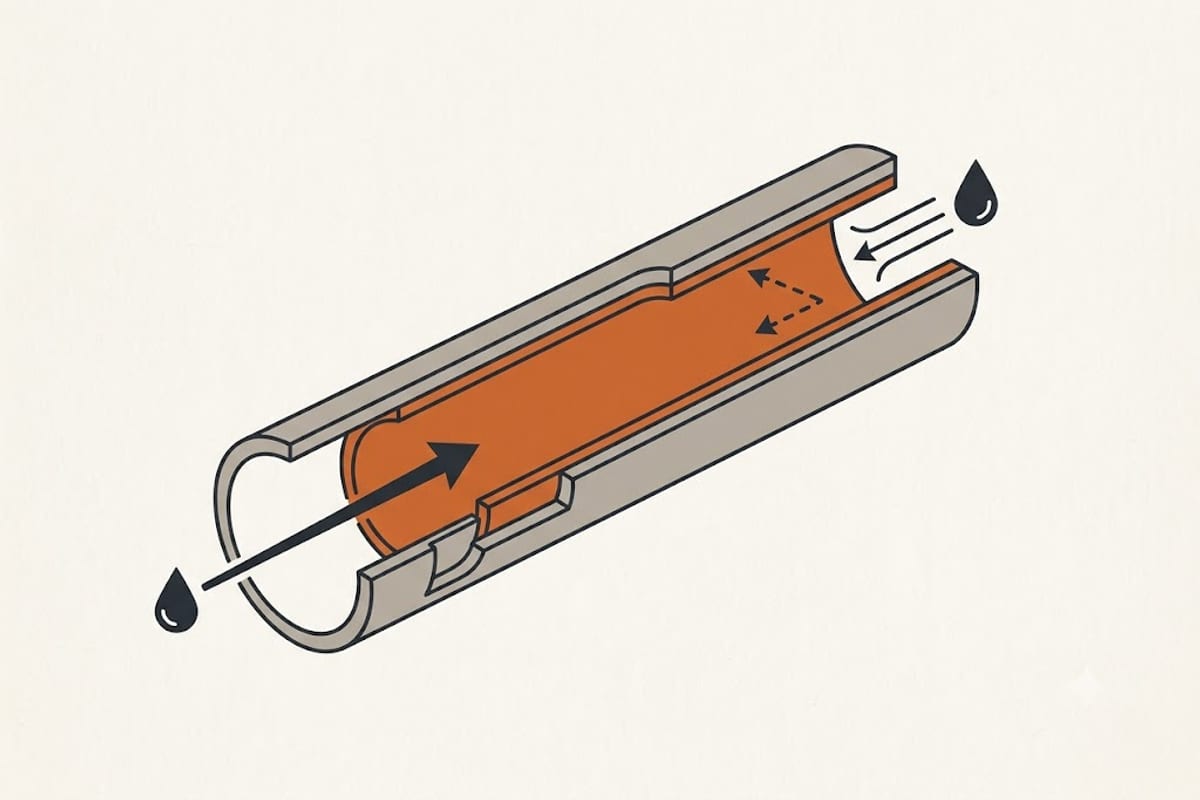
Scale in the water heater. Deposits on elements and on the tank bottom insulate them, reducing efficiency and shortening the heater's life. This is the largest single cost.
Scale in fixtures and appliances. Shower heads, taps, dishwashers, washing machines, coffee machines and any equipment that heats water.
Scale in pipes, over long periods and in severe hardness, narrowing them.
Soap and detergent consumption. Hardness reacts with soap to form scum rather than lather, so more is needed for the same result.
Spotting on glassware and fixtures, and stiffness in laundry.
Skin and hair feel, which is subjective and is what many households actually care about.
Where the threshold sits
Below about 3.5 gpg — soft to slightly hard. No treatment needed.
3.5 to 7 gpg — moderately hard. Noticeable, and a softener is a preference rather than an economic case.
7 to 10.5 gpg — hard. Scale is accumulating measurably and the case is reasonable.
Above 10.5 gpg — very hard. Softening is generally worth it on equipment life alone.
Get the number before deciding. A test kit costs very little and everything follows from it.
The arithmetic
Against a softener's purchase, installation, salt and water for regeneration, set:
Water heater life, extended meaningfully in hard water.
Appliance life — dishwashers and washing machines.
Detergent and soap, a real recurring saving in very hard water.
Descaling and replacing fixtures.
In very hard water the case is comfortable. In moderately hard water it is a preference, and there is no dishonest answer.
What a softener does not do
It does not purify. It removes hardness. Bacteria, nitrate, arsenic, lead and taste are separate problems needing separate treatment.
It does not remove much iron. Small amounts, at the cost of capacity; anything more needs an iron filter ahead of it.
It does not improve taste for most people, and some find softened water tastes flat.
The trade-offs
Sodium added in proportion to the hardness removed — small for most households, and a consideration under a medical restriction. Potassium chloride is the alternative, or leaving the cold kitchen tap unsoftened.
Salt and water consumed at each regeneration.
Discharge, which matters on a septic system and where local rules restrict it.
Softened water is more aggressive toward water heater anodes, so the anode needs checking more often — which is a maintenance point rather than an argument against.
Salt-free conditioners
Template-assisted crystallisation and similar devices change how scale forms rather than removing hardness.
They reduce scale deposition, they use no salt and no water and produce no discharge, and they do not soften water in the sense of lather and feel.
Where scale is the objection they are worth considering, particularly on a septic system. Where the objection is soap, laundry and skin, they will not satisfy it.
The order to decide in
Test the water. Read the hardness and the iron. If the hardness is high enough to matter, size a softener from the grain load. If iron is present above a small amount, plan an iron filter ahead of it.
Doing it in that order is what avoids buying equipment that treats the wrong thing.
Renting versus buying
Water treatment is frequently sold on a rental or a bundled service contract.
Over ten years a rental commonly costs a multiple of the purchase price of an equivalent unit, and the service included is a few visits and salt delivery.
That is a legitimate arrangement for a household that wants no involvement, and it is worth comparing against buying the unit and paying for the occasional service call — which for a softener is a small number of visits over its life.
Municipal water
Utilities publish average hardness in their annual water quality report, and it varies through the year and by source.
A house on municipal water that is moderately hard is usually better served by descaling appliances occasionally than by treating every gallon. Above 10 gpg the calculation looks the same as it does on a well.